
Way of Tea: What is The Role of Herbal Teas in Zen Buddhism?

While the Way of Tea seems a complicated ritual, it is a very simple concept in practice. In fact, it means how tea is part of a peaceful, mindful life. In Japan’s Zen Buddhism, tea was not just a simple beverage. It is a tool for calming the mind, focusing, and entering the present moment.
When you Google “Way of Tea”, you’ll find that, across various Buddhist periods, especially in the School of Mahayana Buddhism, drinking tea always goes along with meditation and inner peace.
When we talk about Zen, we only think of meditation, silence, deep breathing, and a minimalist lifestyle. Tea in Zen Buddhism also falls into the same category. Even simple herbal teas like peppermint, chamomile, or borscht are part of a relaxing experience.
In this article, we explain why tea and Zen go together and what role herbal teas play along this journey.
The Way of Tea in Mahayana Buddhism
The way of tea in Zen Buddhism is not a ritual, but a practice. That is, Buddhists did not drink tea just to quench their thirst. They drink tea to enter a more relaxed state. When Zen monks meditate for many hours, tea reduces their drowsiness and helps them concentrate better. Green tea, as well as several other herbal teas, if brewed slowly and carefully enough, leads the mind to silence and presence in the moment.
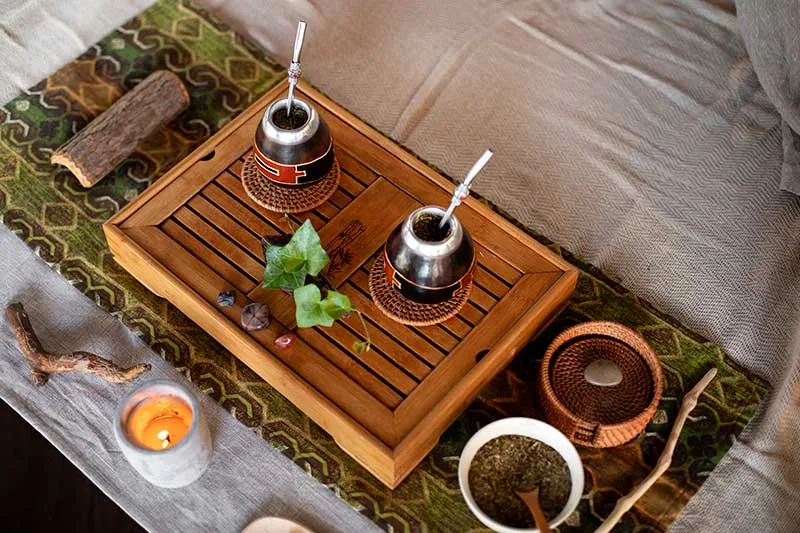
In Mahayana Buddhism, great importance is given to awareness, kindness, and a deep understanding of life. One of the main methods of this school is that a person should be present and conscious even when performing simple tasks. For this reason, preparing tea and drinking it became a simple practice. The monks also believed that when you focus on small tasks, you will definitely be more capable of dealing with big tasks and challenges.
Simplicity & Zen
In Zen, there was a lot of emphasis on simplicity. Tea utensils are also usually simple:
- A kettle or teapot
- A cup, water
- One or multiple herbs for brewing tea
This simplicity taught people that they did not need to pursue great things. Sometimes even a cup of tea calms the mind. Herbal teas found a good place in this path. Because for Buddhists, plants are part of nature, and using them for brewing tea, as a traditional medicine, or in aromatherapy also allows humans to connect more with nature.
For example, chamomile tea is used for relaxation, peppermint for opening the mind, and ginger for warming the body. Of course, these uses are not very formal and were more in the form of a natural and everyday experience.
Among the topics that Zen Buddhists value the most is the issue of mindfulness or momentary awareness. That is, everything you do should be with attention. When you brew tea, the sound of the water boiling, the smell of the herbs, the heat of the cup, and even the first sip of tea, all of it is a form of meditation.
In fact, the Way of Tea implies that life is not just about doing big things; even the little things have a spiritual path. Some people like it, and some people think it’s too simple. But the goal of Zen is simplicity and mindfulness.
The Role of Herbal Teas
When we talk about tea in Buddhism, we don’t just mean green tea or matcha. Herbal teas play a similar role, especially for those looking for a mild, soothing flavor. What’s important is how you approach tea, not what kind of tea you drink.

For those who enjoy yoga or a healthy lifestyle, the Way of Tea is like a short meditation. In the morning or evening, you take a minute or two to brew a cup of tea and sip it with concentration. This allows the mind to disconnect from the hustle and bustle of everyday life and focus on the body and the present moment.
That’s why when you Google “Way of Tea in Buddhism”, most of what you see about this philosophy is simple, like how tea makes life calmer and the mind more focused. This philosophy is for those who are interested in a light, yogic, and peaceful spirituality. Nothing complicated, nothing heavy religious; just a simple way to live better.
Conclusion
In conclusion, if we want to explain the role of tea or herbal teas in Zen, the answer is very simple: tea is a tool for relaxation. In Zen Buddhism, tea is not just an ordinary drink. It becomes a moment of awareness, a brief opportunity to take a deep breath and stop the mind.
In the Mahayana school, simple and daily practices are also of great value, so tea falls exactly into this path. Whether it is green tea or a simple herbal tea such as chamomile or mint; if prepared and drunk with the presence of mind, it will be a small part of the “way of tea”. This way teaches us to find peace in small things.
That is, it is not necessary to enter into difficult meditations or complex rituals. Just sitting for a few minutes, boiling water and drinking a hot herbal drink with full attention is a kind of Zen practice in itself.
